
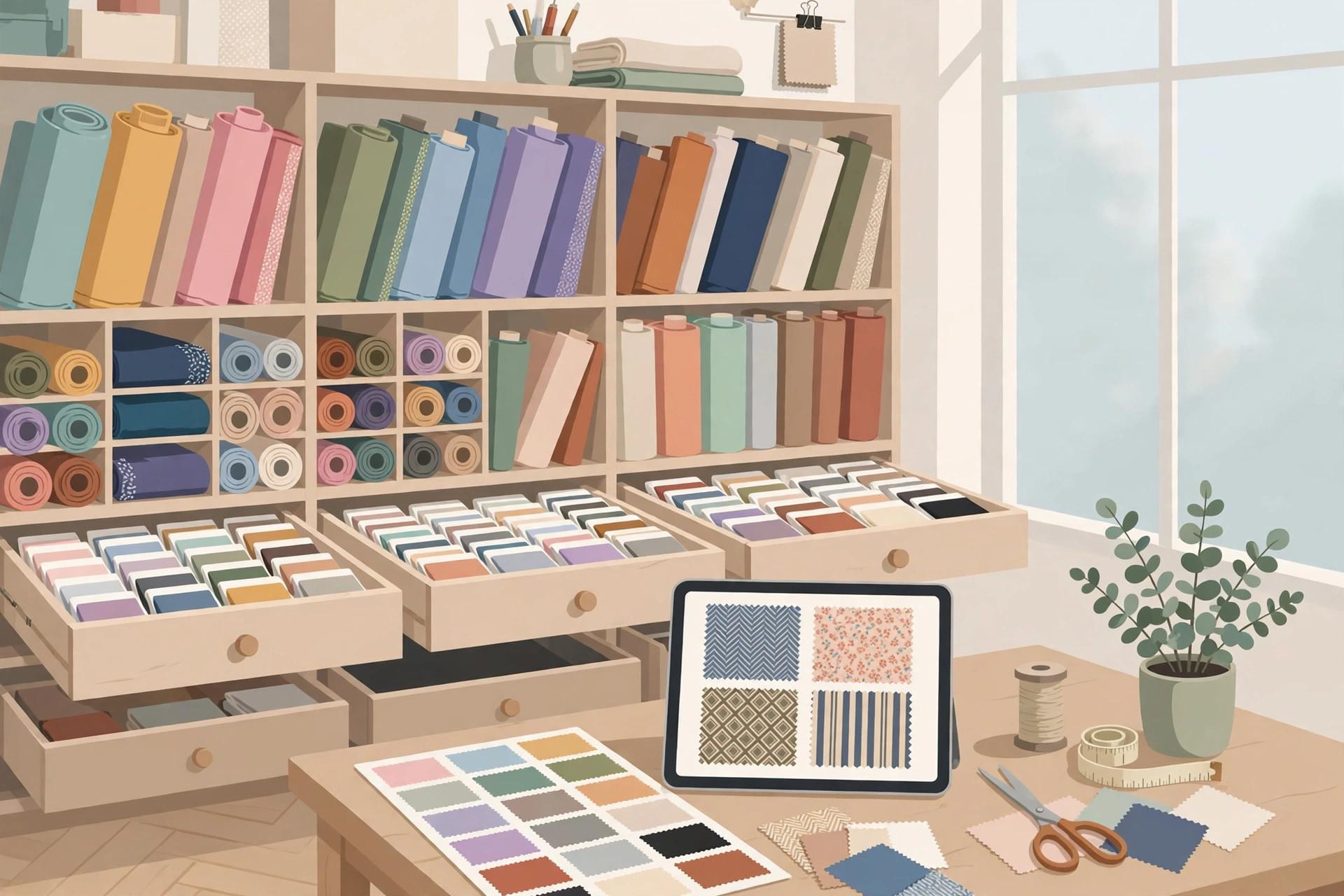
Every fashion collection starts, in a practical sense, with fabric. Before a silhouette is drawn or a pattern is cut, someone has to know what materials are available, what they cost, how they behave, and whether they have been used before. In a traditional workflow, that knowledge lives in a room full of swatch cards, in a filing cabinet, or in the memory of one senior designer. When that person is on holiday, or when a new collection starts in a hurry, the team often orders new fabric simply because nobody can quickly confirm what the company already owns.
A digital fabric library changes that by turning material knowledge into something searchable. Each fabric is recorded with its properties, its appearance, its behaviour in a garment, and the styles it has already been used in. A designer looking for a mid-weight woven with a soft hand does not have to walk to a swatch room and hope; they can search the library and see what the company has already tested. The result is not just speed. It is a quieter, more confident kind of design, where choices are made from knowledge rather than from whatever happened to be within reach.
What Belongs in a Fabric Library
A useful library records more than a picture of a fabric. It records how the material drapes, how it stretches, how it takes colour, and how it behaves after washing. It notes the weight, the composition, and the way the fabric looks under different light. It also records the history of each material: which collections used it, which garments it worked well in, and where it caused problems. That history is often the most valuable part, because a fabric that failed in one context may be perfect in another, and a team that can see the full record will not repeat an old mistake or overlook a good option.
The library also needs to be honest about what it does not know. A fabric that has never been tested in a particular construction should say so, rather than letting a designer assume it will behave the same way it did in a different garment. Good libraries are maintained like any other shared resource: someone is responsible for keeping records current, adding new materials when they arrive, and removing or flagging materials that are no longer available. Without that discipline, a library slowly turns into a catalogue of wishes rather than a record of what the team can actually use.
Sourcing new materials is where a library pays for itself a second time. When a designer finds a fabric in the library that has already been approved by the team, there is no need to request a new sample from a supplier, wait for it to arrive, and test it from scratch. The material can go straight into development, and the supplier relationship stays simple because the order is for a known quantity of a known fabric. Over a season, those saved sample rounds add up to real money and real time, and the team can spend both on the collection instead of on administration. A library also makes it easier to work with new suppliers, because the team can show exactly what it needs, the properties, the colour standard, the behaviour, instead of describing it in words and hoping the sample that arrives is close enough. And when a supplier suggests a substitute, the team can check the library first and see whether a material it already owns would do the same job, which often turns a rushed new order into a simple decision to reuse something proven.
Reusing Materials Without Repeating Collections
Reusing a fabric does not mean repeating a design. The same material can appear in a tailored jacket one season and a relaxed shirt the next, and the customer will never connect the two. What reuse saves is the testing, the sourcing, and the risk: a material the team already understands can go into development with confidence, while a new material needs time and attention before it earns the same trust. Teams that reuse well often find they can spend more of their development time on silhouette and detail, because the material questions have already been answered. Teams that want to see how this works in practice can explore the Style3D Fabric digital materials, where every material is searchable and every past use is visible.
Colour, Consistency and the Second Season
One of the hardest things in fashion is keeping colour consistent across collections and across suppliers. A fabric that looked right in one season can arrive slightly different in the next, and a team that relies on memory will argue about whether the difference matters. A digital record gives everyone the same reference: the same colour standard, the same material data, and the same history of what was approved. When a supplier sends a new batch, the team can compare it with the record rather than with a faded swatch card, and the conversation becomes about facts rather than impressions.
Also read: The Refine Loop: How to Improve AI Images Round by Round
A fabric library also makes sustainability a practical habit rather than a slogan. Reusing a tested material means fewer new orders, fewer samples, and less waste from materials that were bought, tested once, and forgotten. It also means the team can plan collections around what it already has, rather than starting every season from zero. None of this happens by itself. A library only works if the team uses it, maintains it, and trusts it, and that trust is built one accurate record at a time. Paired with a StyleWork AI fashion workspace, where the materials, the designs and the development work sit in the same place, a fabric library stops being an archive and becomes part of how the team designs every day.